
Build confidence in your organisation
We track and measure what we value. What we don't track and measure we neglect.
The question for organisations is what to track and measure. This comes down to what does the organisation values and what in the organisation creates value. A publicaly listed company may track share prices. A government department might track the cost of a process or adverse media reports. A not-for-profit may track the number of meals delivered. Each organisation is doing the same thing. They are adopting ways to define their value, progress and effectiveness.
Put simply, "net value created" = "the outcome" - "the cost of producing it". For financial outcomes we have a variety of tools and measures to nuance this. For social outcomes we can draw on many different indicators.
One risk for organisations is to become over reliant on one or only a few measures. For example, share price and dividends. At first glance this might look fine under corporations requirements to create shareholder value. But, on closer analysis, it could be flawed on any number of levels, such as:
The question for organisations is what to track and measure. This comes down to what does the organisation values and what in the organisation creates value. A publicaly listed company may track share prices. A government department might track the cost of a process or adverse media reports. A not-for-profit may track the number of meals delivered. Each organisation is doing the same thing. They are adopting ways to define their value, progress and effectiveness.
Put simply, "net value created" = "the outcome" - "the cost of producing it". For financial outcomes we have a variety of tools and measures to nuance this. For social outcomes we can draw on many different indicators.
One risk for organisations is to become over reliant on one or only a few measures. For example, share price and dividends. At first glance this might look fine under corporations requirements to create shareholder value. But, on closer analysis, it could be flawed on any number of levels, such as:
- It might not indicate long term viability of organisational practices so reduces value for long term investors.
- If the organisation uses exploitative practices, the social discontent could lead to a less peaceful society, undermining a core value in the lives of investors.
- If it ignors quality measures, the damage to brand and intangible value could reduce future incomes and undermine the value result.
- Poor resource and waste practices can result in resource shortages or degrated environments, that push up costs or create a shared environmental loss, which includes a quality of life loss for investors.
Motivation is more than bonuses
Organisations set out goals strategic and business plans as well as performance agreements. For senior executives these may be attached to performance bonuses. In some organisations, the bonus system extends to other people or teams. While a financial incentive can be valued by people it is not the only way goals, milestones and achievements can improve the wellbeing and productivity of people and their organisations. This is important for all organisations, especially those that don't even have use of bonuses.
Achievement and wellbeing
Goals and expectations make it possible for people to succeed. Without clearly defined objectives, people are in the dark about what they should prioritise. Whether they are successful or struggle and fail is up to chance or second-guessing their managers about what they need to do. Surprisingly, even experienced supervisors can give their people ambiguous expectations.
When people are able to get results and this is recognised by them and others, the experience of achievement can boost their wellbeing. This increase in wellbeing can feed back into their productivity, creating a positive reinforcement, upwards spiral. Of course, if we let people fail, a negative reinforcement, downward spiral could eventuate.
The 'quick win' and its effective use
In change management theory, a quick win is an achievement that builds people's confidence in the change. It is designed to encourage people to keep involved and supportive of long term change processes. Part of the qualities of a quick win is that it helps people to experience the benefits of the change early on.
The principle of the quick win can be incorporated into the design of ordinary operations, especially for roles where there is a long lead time between effort and results. Using milestones and helping people to understand the significance of each achievement along the way can help build a forward momentum. This relies on identifying, clarifying, measuring and reporting the these achievements.
A variation of this can be done on sales or production lines, which have repeated short term work rather than long lead times. Targets, whether production or sales numbers, can be tracked, achieved and celebrated.
Further variations have been used to improve health and safety outcomes in construction or patient outcomes in health care.
Organisations set out goals strategic and business plans as well as performance agreements. For senior executives these may be attached to performance bonuses. In some organisations, the bonus system extends to other people or teams. While a financial incentive can be valued by people it is not the only way goals, milestones and achievements can improve the wellbeing and productivity of people and their organisations. This is important for all organisations, especially those that don't even have use of bonuses.
Achievement and wellbeing
Goals and expectations make it possible for people to succeed. Without clearly defined objectives, people are in the dark about what they should prioritise. Whether they are successful or struggle and fail is up to chance or second-guessing their managers about what they need to do. Surprisingly, even experienced supervisors can give their people ambiguous expectations.
When people are able to get results and this is recognised by them and others, the experience of achievement can boost their wellbeing. This increase in wellbeing can feed back into their productivity, creating a positive reinforcement, upwards spiral. Of course, if we let people fail, a negative reinforcement, downward spiral could eventuate.
The 'quick win' and its effective use
In change management theory, a quick win is an achievement that builds people's confidence in the change. It is designed to encourage people to keep involved and supportive of long term change processes. Part of the qualities of a quick win is that it helps people to experience the benefits of the change early on.
The principle of the quick win can be incorporated into the design of ordinary operations, especially for roles where there is a long lead time between effort and results. Using milestones and helping people to understand the significance of each achievement along the way can help build a forward momentum. This relies on identifying, clarifying, measuring and reporting the these achievements.
A variation of this can be done on sales or production lines, which have repeated short term work rather than long lead times. Targets, whether production or sales numbers, can be tracked, achieved and celebrated.
Further variations have been used to improve health and safety outcomes in construction or patient outcomes in health care.
A pulse survey is a simple, frequently repeated survey that monitors over time what people think about their current situation. The key attributes of a pulse survey are its simplicity, repetition and frequency.
The strength of a pulse survey is that it is an easy mechanism to keep people focused on priorities and to track progress at the same time. It is especially valuable for culture change, where a complex range of factors can be monitored using a simple data set.
Simplicity
Pulse surveys must have a simple design and able to be completed in a couple of minutes. Anything longer and participation will drop as people will tire of giving up large chunks of time repeatedly.
Typically a survey may be five to twenty items, usually a simple statement, with a Likert-type scale. The only other information gathered is to identify the respondent's group or role in the organisation.
Reptition
Pulse surveys must be repeated frequently, using the same set of items, so variations and trends can be identified. The simplicity of design is what makes it possible to ask people to complete the survey repeatedly over a short period of time.
Frequency
Pulse surveys are different to other point in time surveys. Pulse surveys are looking for trends over relatively short period of time. Annual surveys are too far apart to be a pulse survey, even though they may pick up long term trends. The 12 month gap is too large to identify variations and influencing factors.
For pulse surveys the interval between reptitions is short, ranging anywhere between weeks and months. The frequency of samples depends on the size of the survey, the rate of expected change and the ability to respond.
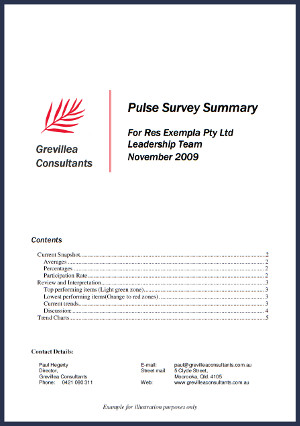
Sample pulse survey report
Benefits
Pulse surveys help groups self-monitor and respond to their own decisions and behaviours. It is important that the results of pulse surveys are shared with the participants so they can respond to it. Concealing the data will reduce participation rates as it is unlikely that organisational leaders can implement change quickly or effectively enough to maintian confidence in the process.
Sharing results enables people to share responsibility for getting a result. From the participants' point of view its about honing their choices and actions. For leaders it helps them engage people in conversation and planning about what to do. Depending on the items in the survey, the results can help leaders identify where trust issues exist so they can focus on where they need to act to build or restore trust. The survey can be particularly helpful for performance management during culture change, highlighting for leaders the areas in need of positive reinforcement.
Qualitative Support
With large groups, pulse surveys can highlight trends or immovable issues. However, a pulse survey is a simple quantitative measure (how many people rate a topic in a certain way) so it does not draw out the issues behind the results.
Typically there are two ways to draw out the reasons behind the results.
The first is for leaders to engage in conversation, asking participants to explain their concerns and explore what can be done. This approach is useful for smaller groups or sub-groups in situations that have a pre-existing rapport and high levels of trust.
For larger groups or where trust is an issue a structured qualitative inquiry is a useful way forward. This is a randomised set of short interviews designed to bring out the themes and issues behind people's responses. The thematic nature of the process means only a small proportion of the respondent group needs to be interviewed. Exploring one issue for a group of 300 respondents may only need around 10 to 15 short interviews (15 minutes each) before saturation point is reached and all the themes and core issues have been identified.
The strength of a pulse survey is that it is an easy mechanism to keep people focused on priorities and to track progress at the same time. It is especially valuable for culture change, where a complex range of factors can be monitored using a simple data set.
Simplicity
Pulse surveys must have a simple design and able to be completed in a couple of minutes. Anything longer and participation will drop as people will tire of giving up large chunks of time repeatedly.
Typically a survey may be five to twenty items, usually a simple statement, with a Likert-type scale. The only other information gathered is to identify the respondent's group or role in the organisation.
Reptition
Pulse surveys must be repeated frequently, using the same set of items, so variations and trends can be identified. The simplicity of design is what makes it possible to ask people to complete the survey repeatedly over a short period of time.
Frequency
Pulse surveys are different to other point in time surveys. Pulse surveys are looking for trends over relatively short period of time. Annual surveys are too far apart to be a pulse survey, even though they may pick up long term trends. The 12 month gap is too large to identify variations and influencing factors.
For pulse surveys the interval between reptitions is short, ranging anywhere between weeks and months. The frequency of samples depends on the size of the survey, the rate of expected change and the ability to respond.
Benefits
Pulse surveys help groups self-monitor and respond to their own decisions and behaviours. It is important that the results of pulse surveys are shared with the participants so they can respond to it. Concealing the data will reduce participation rates as it is unlikely that organisational leaders can implement change quickly or effectively enough to maintian confidence in the process.
Sharing results enables people to share responsibility for getting a result. From the participants' point of view its about honing their choices and actions. For leaders it helps them engage people in conversation and planning about what to do. Depending on the items in the survey, the results can help leaders identify where trust issues exist so they can focus on where they need to act to build or restore trust. The survey can be particularly helpful for performance management during culture change, highlighting for leaders the areas in need of positive reinforcement.
Qualitative Support
With large groups, pulse surveys can highlight trends or immovable issues. However, a pulse survey is a simple quantitative measure (how many people rate a topic in a certain way) so it does not draw out the issues behind the results.
Typically there are two ways to draw out the reasons behind the results.
The first is for leaders to engage in conversation, asking participants to explain their concerns and explore what can be done. This approach is useful for smaller groups or sub-groups in situations that have a pre-existing rapport and high levels of trust.
For larger groups or where trust is an issue a structured qualitative inquiry is a useful way forward. This is a randomised set of short interviews designed to bring out the themes and issues behind people's responses. The thematic nature of the process means only a small proportion of the respondent group needs to be interviewed. Exploring one issue for a group of 300 respondents may only need around 10 to 15 short interviews (15 minutes each) before saturation point is reached and all the themes and core issues have been identified.
Results look different across many roles and levels of the organisations. It can be difficult in some situations to determine whether the results a team is working towards are really the ones that will help the organisation by creating value for customers or contributing to it. Selecting the right results goals to focus on for any given team depends on understanding the value priorities of the stakeholders.
In the Performance Panel this is addressed as the question of validity. To maintain the commitment and loyalty of customers and investors it is important to be able to demonstrate to them that your are creating value for them. However, their needs and priorities vary.
If their focus is on cost, they will be looking for different priorities than if their focus were on quality. However they might not declare this, hoping to get the best quality even though they're commitment will be determined by cost. Similarly, if the focus of an investor, including the CEO who determines the budgets and performance targets, is on cost, then they will want to see efficiency and process gains, compared to when the emphasis is on outcomes. They will still want value for money but the quality is important.
Often times a stakeholder will never admit what their emphasis is, especially if they think they might look bad for admitting it. If a team or organisation is going to demonstrate the validity of what they are providing then they will have to work out the customer's or investor's priorities and provide the corresponding evidence and experience.
In the Performance Panel this is addressed as the question of validity. To maintain the commitment and loyalty of customers and investors it is important to be able to demonstrate to them that your are creating value for them. However, their needs and priorities vary.
If their focus is on cost, they will be looking for different priorities than if their focus were on quality. However they might not declare this, hoping to get the best quality even though they're commitment will be determined by cost. Similarly, if the focus of an investor, including the CEO who determines the budgets and performance targets, is on cost, then they will want to see efficiency and process gains, compared to when the emphasis is on outcomes. They will still want value for money but the quality is important.
Often times a stakeholder will never admit what their emphasis is, especially if they think they might look bad for admitting it. If a team or organisation is going to demonstrate the validity of what they are providing then they will have to work out the customer's or investor's priorities and provide the corresponding evidence and experience.
The level of emotional engagement of customers is a key indicator of the effectiveness of your organisation. Customer satisfaction will not create loyalty. There are usually multiple providers who can satisfy a need. Their loyalty comes when they are emotionally engaged with you, that is, when dealing with you gives them an emotional payoff that other competent providers do not provide.
The emotional payoff can come from a range of factors, including they way you make them feel about themselves, the convenience of your service, prestige, ethcial standards, and even identifying with the character, culture or personal values of your people and organisation. People will even pay a premium for the emotional payoff.
So an important focus in any dealings is the emotional connection. This flows from rapport, integrity, the quality of your products and services, the stakeholder's experience of dealing with you and your ability to demonstrate commitment to them. A very simple measure of this complex dynamic is simply to find out whether they would recommend you or your organisation to a friend.
The emotional payoff can come from a range of factors, including they way you make them feel about themselves, the convenience of your service, prestige, ethcial standards, and even identifying with the character, culture or personal values of your people and organisation. People will even pay a premium for the emotional payoff.
So an important focus in any dealings is the emotional connection. This flows from rapport, integrity, the quality of your products and services, the stakeholder's experience of dealing with you and your ability to demonstrate commitment to them. A very simple measure of this complex dynamic is simply to find out whether they would recommend you or your organisation to a friend.